Introduction: why domain lists matter for SMBs
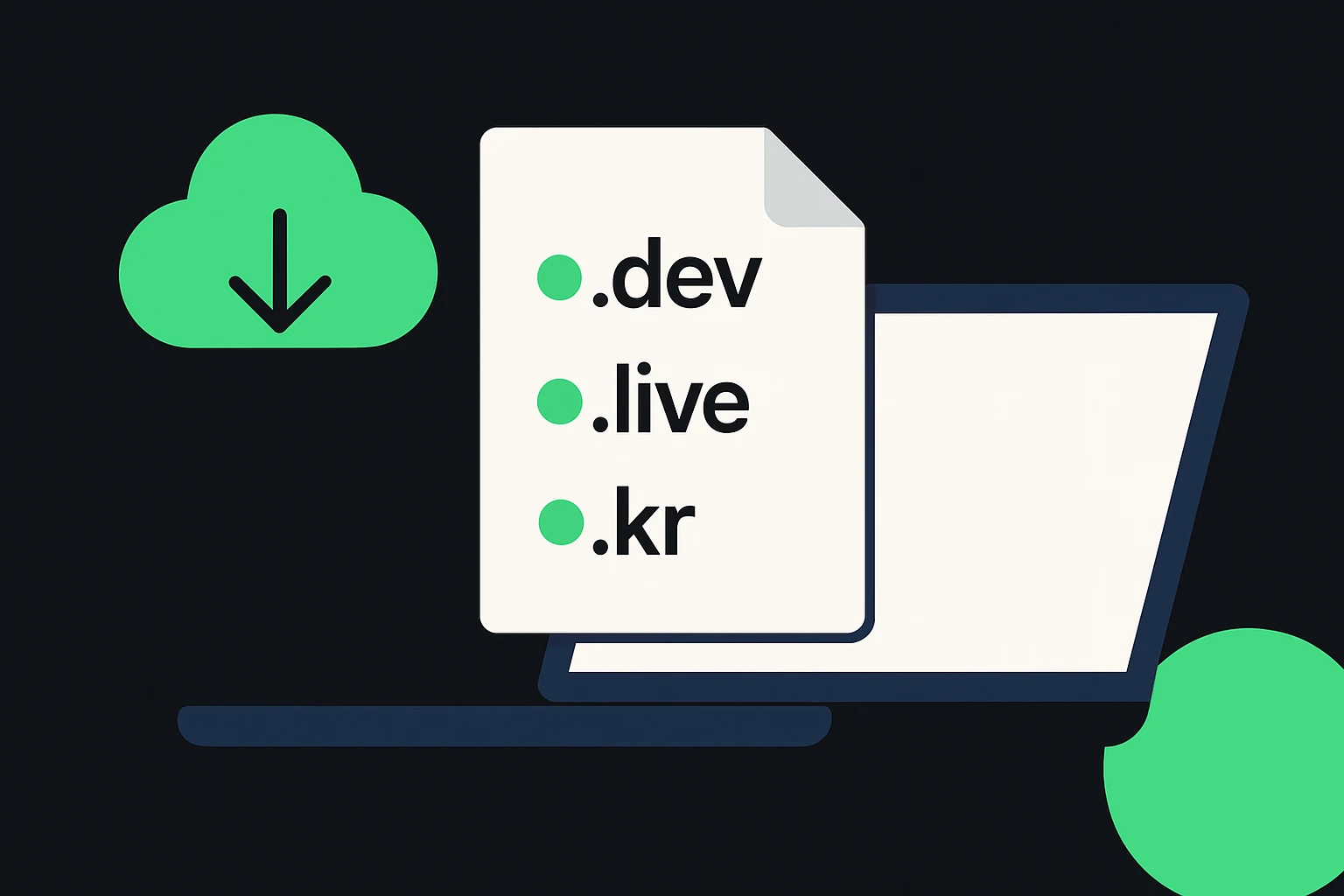
For US small and midsize businesses building an online brand, the right domain strategy can extend reach, protect identity, and avoid confusing competitors’ signals. Part of that strategy is understanding how to explore domain inventories - especially for newer or non-traditional top-level domains (TLDs) like .dev and .live, and country-code TLDs such as .kr. The phrase download list of .dev domains, often cited in industry conversations, is shorthand for a broader capability: access to bulk domain data that helps you gauge risk, branding opportunities, and campaign hygiene. This article distills what that data looks like, how you can access it responsibly, and what trade-offs SMBs should consider.
Understanding the TLD landscape: what .dev, .live, and .kr mean for SMBs
Top-level domains come in several flavors. .dev is a generic TLD focused on developers and technology, operated by Google Registry. Its purpose and security posture are part of its branding and trust equation for technology-forward audiences. Google Registry’s .dev policy explains registration rules and security requirements for .dev domains. This governance shape influences how brands think about using or acquiring .dev domains as part of a broader online presence. (registry.google)
Similarly, .live is a newer gTLD managed by a registry (Donuts, now Identity Digital in many contexts) that targets live content, events, or streaming-oriented branding. Its registries have highlighted protective measures like brand protections to minimize homograph abuse, a factor SMBs should weigh when considering a live-content strategy. See coverage of .live and registry context in industry announcements. (prnewswire.com)
Country-code TLDs (ccTLDs) like .kr (Korea) map to geographic markets and offer localization advantages. Access policies vary by registry, with bulk access largely governed by ICANN’s CZDS framework, which is designed to provide approved third parties with bulk zone data under strict terms. (czds.icann.org)
How bulk domain data works in practice
When people say download list of .dev domains or download list of .kr domains, they are usually referring to zone file data - the authoritative lists that underpin which domains exist within a TLD. Zone files are not always freely downloadable by everyone, access is typically controlled through formal processes that prove legitimate, compliant use. The Centralized Zone Data Service (CZDS) is ICANN’s portal for requesting access to zone files from participating registries. If you’re evaluating domain data for brand protection, security, or market analysis, CZDS is a key pathway to legitimate, structured data.
Key point: the availability and format of zone files depend on the registry and applicable agreements. Registry operators must provide bulk access to zone files under specific conditions, and there are safeguards around data use, distribution, and privacy. SMBs should treat any bulk data project as a policy- and ethics-conscious effort, not a fishing expedition for loopholes.
For organizations seeking to start, the CZDS portal is your official gateway to bulk zone files for gTLDs that participate in the program. If a particular TLD does not appear in CZDS, it may require direct engagement with the registry or a registrar for alternative data access options.
Practical takeaway: bulk domain data is incredibly powerful for research and risk assessment, but it requires a legitimate justification and a formal data-access process. For SMBs, that typically means security, brand protection, or strategic planning needs that justify the data request. (czds.icann.org)
A practical workflow to approach domain data for SMBs
Below is a concise framework SMBs can adopt to responsibly explore domain inventories without overreaching legal or compliance boundaries. This framework uses the idea of a minimum viable data project to test value before expanding to broader datasets.
- Define objectives and guardrails: Clarify what you want to learn from domain data (brand risk, naming opportunities, regional branding). Set guardrails around data use, privacy, and non-marketing automation.
- Identify access paths: For gTLDs like .dev and .live, start with CZDS if your use case qualifies, for ccTLDs like .kr, check registry-specific policies and potential direct registry/registrar access. The CZDS portal is the official starting point for bulk zone data. (czds.icann.org)
- Submit a compliant access request: Prepare a description of your legitimate use case, your compliance posture, and how you will store and protect data. ICANN’s CZDS and registry agreements outline expectations for access and data handling. (icann.org)
- Validate and clean data: Bulk lists are large and may contain stale or duplicate entries. You’ll need to deduplicate, verify accuracy, and align domain data with your brand protection and security workflows. Consider cross-referencing with RDAP/WHOIS data for current ownership where permissible.
- Integrate insights into decision-making: Use domain data to inform brand protection strategies, naming experiments, and risk monitoring, rather than treating lists as a shortcut to quick acquisitions. For example, monitoring .dev domains can help identify brand-infringing registrations that could impact developer-focused campaigns.
A concrete, user-focused path: from interest to action
If you’re evaluating the practical steps to obtain domain data tied to the keywords you care about, here is how you can translate intent into action while staying within best practices:
- For .dev domain lists, begin with your registry’s official pages to understand the policy and availability, then explore CZDS as a potential route for bulk data access if your use case fits. The .dev policy and Google Registry communications provide essential context for how this TLD is managed. Google Registry - .dev policy. (registry.google)
- For .live domain data, recognize that .live is a Donuts registry asset with brand-protection tools designed to guard against lookalike registrations. Public-facing announcements describe the registry’s approach to branding and protection. Donuts .live program and brand protection. (prnewswire.com)
- For .kr domain data, consider ICANN CZDS guidance and registry-specific policies for bulk access, noting that ccTLDs vary widely in data-sharing practices. ICANN’s CZDS framework is the starting point for bulk zone data access in generic contexts. CZDS overview. (czds.icann.org)
Limitations, trade-offs, and common mistakes SMBs should avoid
Bulk domain data offers powerful insights but comes with real caveats. Here are the most common missteps and how to avoid them:
- Mistake: assuming bulk lists are perfectly current – Zone files are update streams, but there can be delays and discrepancies. Always corroborate with current ownership data where privacy rules allow, and understand the update cadence of the data source.
- Trade-off: privacy vs. comprehensiveness – Accessing bulk domain data requires handling potentially sensitive information. Use data responsibly, with proper storage controls and a clear legitimate-use justification. CZDS access is conditional and auditable. (czds.icann.org)
- Limitation: not all TLDs are equally accessible – Some registries offer limited bulk data or require direct engagement outside CZDS. Plan for longer lead times and alternative data pathways if the TLD you care about isn’t CZDS-listed. (icann.org)
- Risk: misinterpreting data for acquisition decisions – Bulk lists are a starting point for risk assessment and discovery, not a ready-made inventory for immediate purchases. Align findings with a defined brand-protection and security workflow.
Structured framework: a four-step approach to domain data for SMBs
Use this concise framework to organize a domain-data initiative without getting lost in the data lake. This block is designed to be a practical, reusable tool you can drop into a project plan.
- Step 1 - Define goal and scope: Decide whether you’re assessing risk, exploring naming opportunities, or monitoring competitors. Cap the scope to avoid data bloat and to keep your initiative actionable.
- Step 2 - Choose access path: Start with CZDS for eligible gTLDs, contact registries directly for others, ensure you meet data-use requirements before proceeding.
- Step 3 - Validate and normalize: Clean duplicates, correct obvious errors, and align the data with your internal asset registry. Use ownership data where permissible to verify legitimacy.
- Step 4 - Integrate into decision workflows: Feed insights into your brand-protection, red-team monitoring, and marketing alignment processes. Treat domain data as a governance asset, not a purchase shortcut.
How VCweb Digital Agency fits into this picture
As a web design and digital marketing partner for SMBs, VCweb understands that domain strategy is more than a shopping list - it’s a governance and brand-safety practice. While the bulk data you obtain can illuminate naming opportunities and risk exposure, the real value comes from how you operationalize those insights into robust hosting, site performance, and marketing strategy. Our team can help you translate domain-data insights into a cohesive web presence, from secure hosting and fast page loads to SEO foundations and paid media alignment. For readers exploring domain data workflows, consider these practical integrations with your overall digital strategy: download the .dev domains list as a starting data point for developer-focused branding, or explore the broader TLD list hub to frame your approach. For more on data provenance and domain ownership, you can also consult RDAP & WHOIS database, which provides context on current registration records.
Expert insight and a note on limitations
Expert insight: Domain data initiatives should be paired with a governance rubric. In practice, successful SMBs combine domain data with a formal brand-protection program and a clear data-use policy to avoid regulatory and privacy pitfalls while still gaining strategic visibility into the domain landscape.
Limitation: While bulk domain data can reveal registrations and potential brand risks, it often cannot be treated as a turnkey inventory for instant acquisitions. Ownership data may be restricted, and update cadences vary by registry - so data should be seen as a part of a broader, ongoing governance and risk-management effort.
Conclusion: a disciplined path to domain insight
Accessing domain data - whether via .dev, .live, or .kr inventories - offers SMBs a powerful lens into branding, risk, and expansion opportunities. The key is to balance ambition with governance: start with clear objectives, use official data-access channels like CZDS when available, and integrate findings into a broader strategy that covers hosting, SEO, and digital marketing. For SMBs ready to begin, the following starting points can help you move from curiosity to action in a responsible way: explore the .dev data path, understand .live’s brand-protection approach, and follow CZDS guidance for bulk zone data access. And as you chart your course, consider how a partner like VCweb can help you translate domain insights into a stronger, faster, more secure digital presence.
Additional resources and direct destinations: