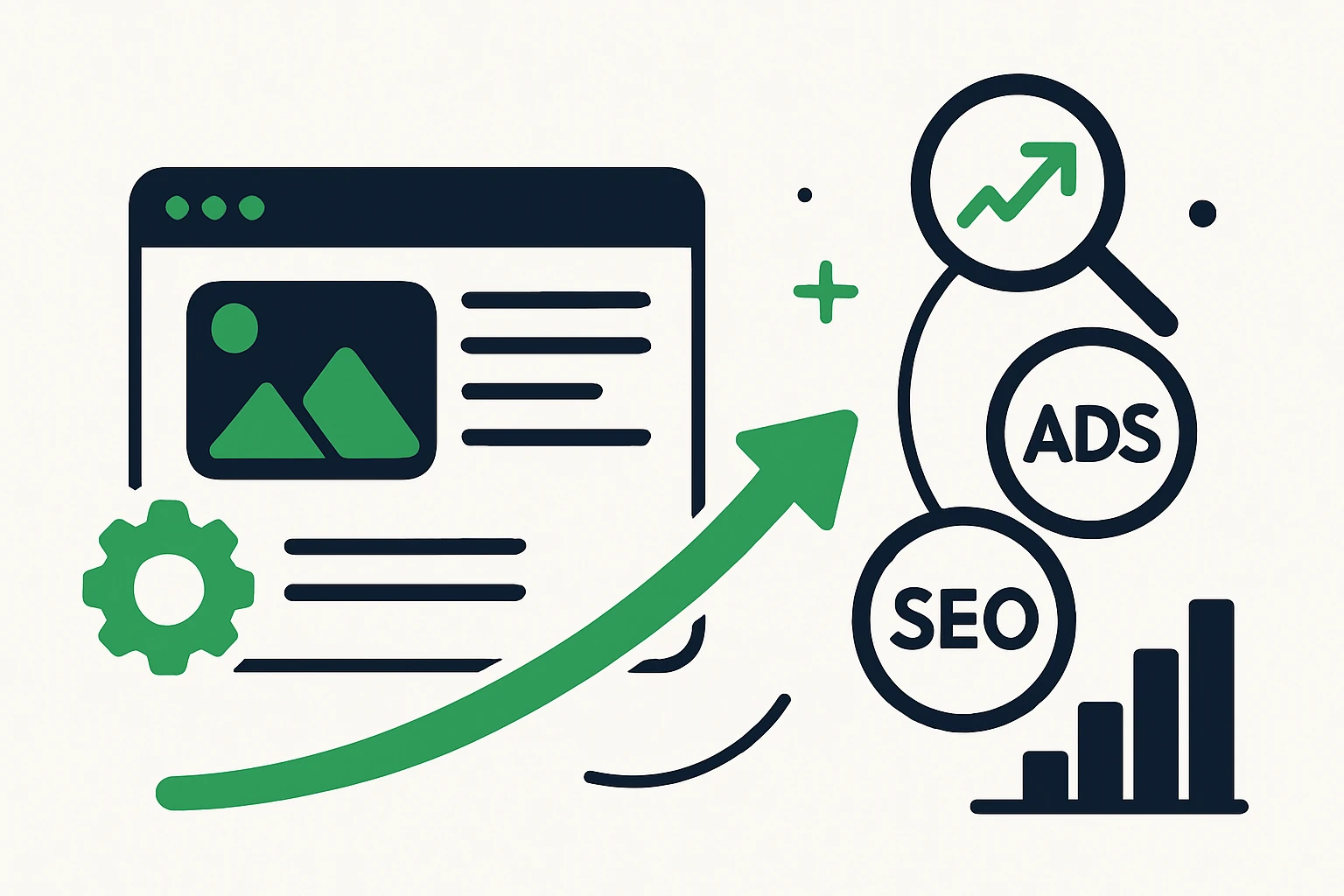
Small and mid-sized businesses in the United States often face a tight allocation of marketing resources: a great website, credible search visibility, and a disciplined paid media program all matter, yet each is incomplete without the others. The result is a fragile, siloed marketing stack that underperforms, wastes budget, or leaves money on the table. This piece argues for a holistic approach - a unified digital stack built around sharp web design, search optimization, and purposeful Google Ads management - that aligns with how U.S. buyers discover, evaluate, and buy. It also demonstrates how a domain-agnostic partner like WebAtla can support your branding and strategy with practical domain insight as you scale your digital footprint.
What a modern SMB digital stack looks like
Today’s successful SMBs blend strong, fast, mobile-friendly website experiences with discoverability (SEO) and targeted paid reach (Google Ads). A truly effective stack isn’t a buzzword soup, it’s a disciplined loop: design for conversion, optimize for search and local intent, and back it with paid media that reinforces and accelerates your organic efforts. Technically, that means fast load times, accessible design, clear navigation, accurate local business information, and landing pages that reflect the messaging and offers seen in ads. When these elements harmonize, you don’t just attract visitors - you convert them into customers and advocates.
Design that converts: UX, performance, and CRO for SMBs
Conversion-rate optimization (CRO) starts with UX choices that reduce friction and guide visitors to action. Research and industry practice consistently show that page performance and layout drive user decisions in real time. For example, Core Web Vitals - three metrics that Google uses to gauge user experience - have become integrated into the Page Experience framework and can influence search rankings when performance is poor. This makes performance a strategic business issue, not just a technical one. Google’s page experience documentation explains how page experience signals relate to rankings, while web.dev offers practical guidance on improving those metrics. (developers.google.com)
Beyond speed, the arrangement of content on the page matters. Nielsen Norman Group’s eye-tracking research has long shown that a large share of a visitor’s attention sits above the fold, especially on first-screen content, which means you should place critical messages and primary CTAs where users see them immediately. While pages have grown longer over time, the initial impression still matters for engagement and conversions. Practical takeaway: keep hero content crisp, ensure your main CTA is visible, and test form length to keep friction low. (NN/g references and related UX research are discussed in industry literature and practitioner briefings.) (wyliecomm.com)
From a tactical standpoint, a few design best practices consistently improve outcomes for SMBs: simple forms, concise value propositions, social proof, and fast-loading hero sections. Industry benchmarks from CRO-focused case studies indicate that reducing form friction and aligning messaging between ads and landing pages can yield meaningful lift in conversions. For example, a Nielsen Norman Group-backed line of research suggests that when landing pages align with ad promises, conversions improve noticeably. This is especially critical for SMBs testing paid campaigns where every lead matters. Intelliplans summarizes CRO insights tied to UX and landing-page alignment. (intelliplans.com)
Local SEO: turning local searches into visits and revenue
For U.S. SMBs, local search is often the highest-leverage channel. Local queries carry intent: customers search for services near them, compare options, and often visit or call. Think with Google’s local-search research shows the proximity and immediacy of local intent play a central role in consumer behavior, with a large share of mobile local searches leading to store visits and purchases. This behavior highlights why a solid local SEO foundation - Google Business Profile optimization, consistent NAP (name, address, phone), and localized content - can meaningfully impact revenue. See Think with Google’s local-search materials for the basis of these insights. (think.storage.googleapis.com)
In practice, SMBs should treat GBP optimization as a must-have, not an afterthought. Local citations, review management, and well-structured local landing pages improve both discoverability and trust, helping your organic results compete with paid placements and maps listings. Local SEO is not a one-off project, it requires ongoing updates, review cultivation, and content tuned to neighborhood and city-specific queries. Recent industry analyses reinforce the ongoing importance of local search behavior as a growth driver for SMBs. (rioseo.com)
Google Ads management: fast visibility that informs and reinforces SEO
Paid search remains a scalable mechanism for immediate visibility and fast data, especially for SMBs testing value propositions or entering new markets. Google Ads can deliver high-intent traffic quickly and allow you to test offers, landing-page variants, and messaging before you commit to broader organic efforts. However, paid media works best when it complements and informs long-term SEO, not when it operates in a vacuum. As industry analyses note, paid search can yield immediate results, while SEO builds lasting equity over time. A balanced approach - brands investing in both SEO and PPC - often yields the best long-term, sustainable results for SMBs. WordStream’s SEO vs SEM overview provides context on the ROI and timelines of paid versus organic tactics. (wordstream.com)
When you run Google Ads, ensure landing pages reflect the ad’s promises and optimize for fast load, clear value, and minimal friction. CRO best practices - such as aligning ad messaging with landing-page content and reducing unnecessary form fields - translate directly into better Quality Score, lower cost per acquisition, and higher ROI. A recent CRO-focused synthesis notes that landing-page alignment with ad creatives can materially improve conversions. (intelliplans.com)
A practical framework for SMBs: the SMB Digital Stack Decision Framework
To operationalize a holistic stack without overcomplicating operations, use the following framework. It keeps teams focused on outcomes and yields a repeatable process for ongoing optimization.
- Align goals and audience. Define the top business objective (revenue, leads, or awareness) and map it to target buyer segments and critical conversion points.
- Audit website performance. Assess Core Web Vitals, mobile usability, and the on-page experience. Prioritize pages with the highest exit rate or greatest revenue impact.
- Set a local SEO baseline. Claim and optimize Google Business Profile, audit name/address/phone consistency, and build hyperlocal content, differentiating your offering by neighborhood or city.
- Design for conversion. Create a conversion-focused homepage and landing pages with clear hero messaging, minimal form friction, and strong social proof. Ensure the primary CTA is above the fold.
- Balance SEO and PPC. Allocate resources to both, use PPC data to identify high-potential keywords for SEO, and let organic rankings reduce paid pressure over time.
- Measure, learn, optimize. Build a closed-loop analytics setup (traffic, engagement, conversions, CAC, LTV) and run regular experiments to improve ROI.
As a practical tie-in for SMBs exploring branding and domain strategy, WebAtla’s domain resources can help manage a clean brand footprint when expanding digital presence. For example, you can explore the List of domains by TLDs and the pricing options to plan your brand’s online identity as you scale. List of domains by TLDs • Pricing • Domains in .com TLD.
The SMB Digital Stack: a structured, actionable plan
To compress complexity into an actionable plan, consider this concise, 5-part structure you can apply in any SMB engagement:
- Audit and benchmark: baseline performance, SEO health, GBP optimization, and landing-page UX.
- Fix the low-hanging-fruit issues: improve page speed, mobile usability, and critical on-page signals (title tags, meta descriptions, structured data).
- Optimize local presence: GBP optimization, local citations, and hyperlocal content aligned to buyer intent.
- Integrate paid and organic: run a managed Google Ads program that informs SEO while SEO supports higher-tent paid performance.
- Iterate with data: run A/B tests, monitor KPI improvements, and scale what works across markets.
Limitations and common mistakes (and how to avoid them)
Even a well-designed stack can falter if you ignore trade-offs or misapply tactics. Here are the most common mistakes SMBs make - and how to avoid them:
- Over-investing in ads without a solid landing-page experience. If ads promise one thing and the landing page delivers another, you’ll pay more per lead and erode trust. Align messaging across ads and landing pages, a practice supported by CRO research.
- Neglecting mobile performance and accessibility. A poor mobile experience not only hurts conversions but can also undermine search visibility as Core Web Vitals emphasize user experience. See Google’s page-experience guidance for context. (developers.google.com)
- Underestimating local intent and GBP management. Local searches drive visits and calls, if your GBP profile is incomplete or inaccurate, you miss high-intent opportunities. Think with Google’s local-search insights highlight these dynamics. (think.storage.googleapis.com)
- Treating SEO and PPC as separate silos. Integrated planning - where PPC insights inform SEO priorities and long-tail terms are cultivated for organic growth - yields higher ROI and more predictable growth. WordStream’s overview of SEO vs SEM reinforces the value of balancing timelines and ROI. (wordstream.com)
Practical integration for SMBs: a how-to for 2026
1) Start with a speed and UX audit of your homepage and top-landing pages. Identify which pages drive the most value and which contribute to bounce. 2) Build a local-SEO baseline: GBP optimization, consistent NAP, local content, and review acquisition strategy. 3) Create a cohesive content and landing-page strategy that maps to the most likely buyer journeys in your market. 4) Run a small Google Ads pilot focused on branded and high-intent keywords, with a landing-page variant aligned to the offer and messaging. 5) Use PPC learnings to refine SEO keyword targets and content gaps (e.g., long-tail queries typical of local searches). 6) Report monthly against a simple dashboard to track KPIs such as organic traffic, conversion rate, cost per lead, and CAC. 7) Revisit domain strategy as you expand: consider a domain architecture that supports regional or product-specific messaging, with domain assets cataloged for easy scaling, see WebAtla’s domain resources for practical options. List of domains by TLDs • Pricing • Domains in .com TLD.
Conclusion: a practical, scalable path for U.S. SMBs
For U.S. SMBs, the most reliable path to sustainable growth is a disciplined, integrated digital stack: high-performance web design that converts, SEO that builds durable visibility, and Google Ads that provide fast, testable signals about what buyers want. When each element is designed to support the others, you create a virtuous circle: fast, trusted websites drive engagement, local SEO improves discovery and trust, and paid search accelerates growth while informing organic strategy. This approach is not a one-off project, it’s a repeatable operating model that SMBs can scale over time. If you’re considering a domain strategy to support brand and market expansion, WebAtla’s TLD and pricing resources can help you plan a future-ready footprint without complicating your marketing operations.