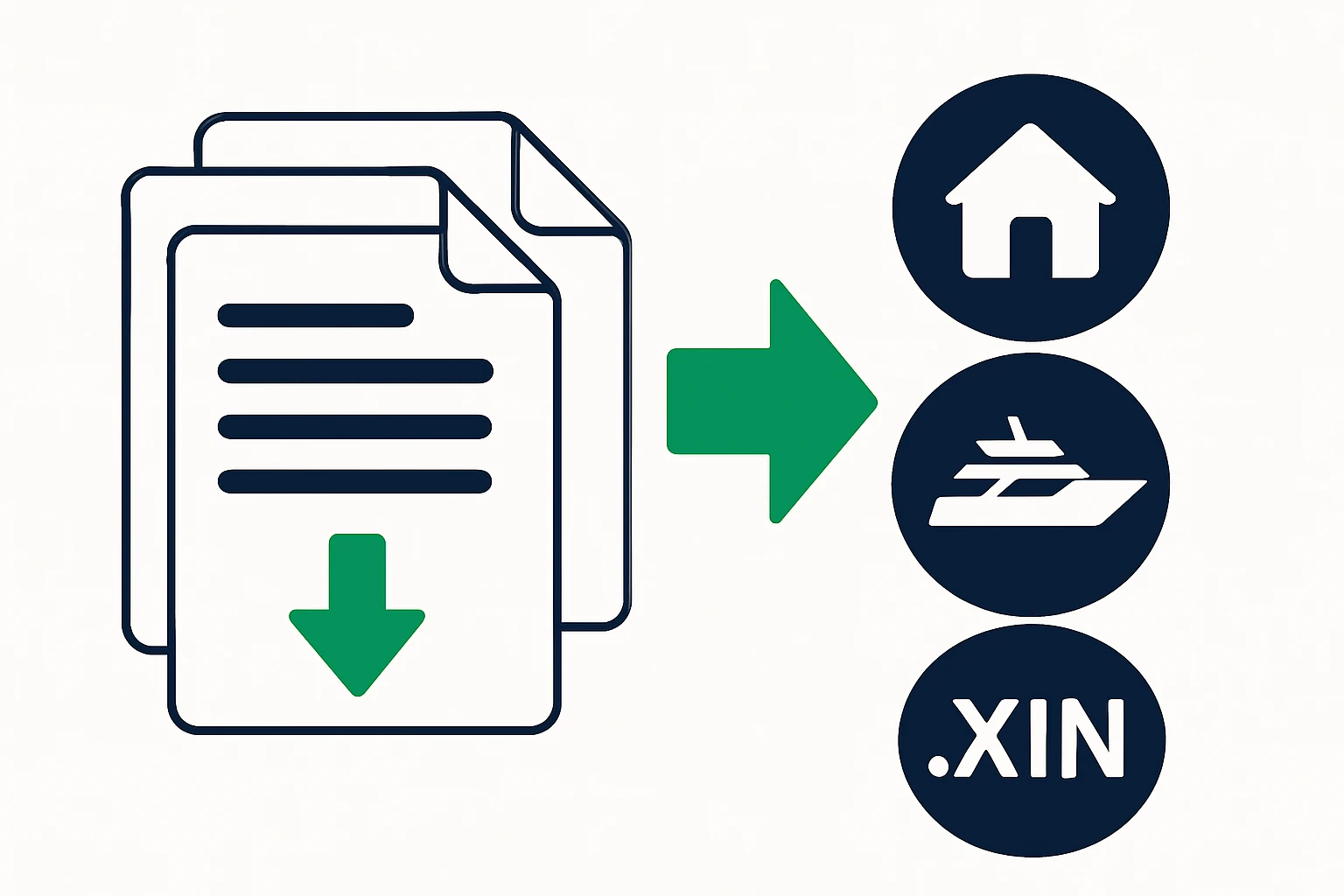
Niche TLDs for SMBs: Download and Evaluate .homes, .yachts, and .xin Domain Lists
For US small and medium-sized businesses building a digital footprint, the domain extension is more than a vanity choice. Niche or new gTLDs such as .homes, .yachts, or .xin can signal relevance and industry focus, while opening opportunities for creative branding. But because these extensions sit outside the traditional .com/.net/.org ecosystem, they also bring unique branding, trust, and SEO trade-offs. The expansion of the domain namespace has been a deliberate policy by ICANN to broaden branding opportunities, with subsequent rounds anticipated in the years ahead. ICANN's New gTLD Program outlines how this expansion works and what it means for brands considering non-traditional extensions. (newgtldprogram.icann.org)
Recent market data reinforce the enduring importance of domain strategy. Verisign’s Domain Name Industry Brief aggregates registrations across all TLDs and shows that the global domain base continues to grow, underscoring that the namespace remains a critical part of online strategy for brands of all sizes. (investor.verisign.com)
SEO practitioners increasingly recognize that the extension itself is not a direct ranking factor - Google and industry analysts emphasize content quality, user signals, and backlinks as primary drivers. This nuance matters when SMBs weigh niche TLDs: a well-executed niche strategy can improve branding and CTR, while poor execution can hamper professional credibility. For a thoughtful treatment of how domain extensions relate to SEO, see industry coverage on domain extensions and SEO dynamics. (searchengineland.com)
As SMBs explore niche domains, many look for practical means to source and evaluate candidate names. A number of providers offer bulk domain data and downloadable lists to facilitate assessment, discovery, and outreach planning. While the precise mechanics vary, the goal remains the same: find viable assets that align with brand, audience, and go-to-market plans. For a sense of how the landscape is evolving, consider the broader domain-data ecosystem and ongoing market signals from major registries. (investor.verisign.com)
In practice, SMBs should approach niche TLDs as part of a holistic branding and digital-marketing plan - not as a stand-alone growth hack. A well-curated list of candidate domains can support brand protection, market differentiation, and content strategy, but it must be paired with strong governance, clear naming conventions, and a plan for post-purchase management. This article walks you through how to download and evaluate niche-domain lists, with a practical framework you can adapt to your business goals. For a quick context on how new gTLDs fit into the larger market, ICANN’s program overview and Verisign’s market data provide grounding points. (newgtldprogram.icann.org)
Understanding niche TLDs: what they are and what they promise
Niche TLDs are part of ICANN’s broader strategy to diversify branding options beyond the long-established .com era. The New gTLD Program opened the door to a wide array of extensions tied to specific industries, geographic focus, or branding concepts. This program is ongoing, with future rounds anticipated, which means niche extensions may become even more commonplace in brand portfolios over time. For readers new to the topic, ICANN’s official materials provide the most reliable overview of how these TLDs are introduced, managed, and evaluated. New gTLDs - ICANN. (newgtlds.icann.org)
From a branding perspective, a .homes modulates expectations for an audience seeking home-related services, while .yachts signals luxury or maritime lifestyle focus, and .xin reflects a broader, more global branding footprint. The key is to ensure that the domain aligns with the product or service narrative you intend to publish under that brand. Market data from Verisign indicates that while new extensions are less ubiquitous than .com, they are part of a dynamic and growing namespace, reinforcing the case for thoughtful evaluation rather than simple substitution. (investor.verisign.com)
SEO literature generally treats TLDs as non-direct ranking signals, however, user perception, brand trust, and click-through behavior can indirectly influence performance. In other words, the extension can affect how your brand is perceived and how users engage with your site, which over time can influence rankings via engagement and backlink signals. For a practical synthesis, see industry analyses that summarize how search engines view domain extensions. (searchengineland.com)
Downloading and evaluating domain lists by TLDs: a practical starter kit
When SMBs embark on a niche TLD initiative, a core task is to assemble and vet candidate domain names. Several pathways exist to obtain bulk lists or datasets that can accelerate discovery and evaluation. In practice, you’ll typically engage in two activities: (1) compiling a broad pool of candidates that fit your brand language and market, and (2) validating these candidates for availability, cost, and risk. The goal is to transform a raw pool into a shortlist you can act on, not to purchase blindly. For market-scale analysis, many teams rely on datasets and tools that offer bulk download and filtering capabilities, enabling rapid scoring against branding and policy criteria. Market signals from registries and industry coverage reinforce the importance of disciplined, data-driven decision-making for domain strategy. (investor.verisign.com)
At the same time, it’s essential to ground the process in a practical workflow. Start with target themes derived from your brand and audience, then pull domain lists that match those themes across the candidate TLDs. Validate the candidates for: (a) spelling, (b) pronunciation, (c) cross-cultural resonance, and (d) trademark risk. Once you have a vetted list, you can map each domain to a specific content or product strategy, ensuring consistent messaging across your digital ecosystem. While many SMBs rely on third-party data providers or domain marketplaces for these lists, you should approach any list with a clear governance plan to avoid confusion and brand dilution. For those looking to explore niche options like .homes, .yachts, or .xin specifically, a reliable starting point for discovery is the niche-domain catalog offered by WebATLA’s TLD pages, which provide a curated catalogue element to the process. download list of .homes domains.
From a data-credibility perspective, reputable market data shows a growing, dynamic namespace, underscoring why many SMBs treat domain-listing activities as a core part of marketing analytics. The landscape is not static, and the value of a niche TLD often depends on how well the domain aligns with your content strategy and user expectations, not merely its novelty. In short, treat this as a disciplined research task rather than a spur-of-the-moment purchase. (investor.verisign.com)
A practical framework to assess niche domain lists
Below is a concise framework that SMBs can apply when they download and evaluate lists for .homes, .yachts, and .xin domains. It’s designed to be implementable with limited resources and to help you avoid common missteps.
- 1) Brand alignment
- Does the domain clearly reflect your core offering or audience?
- Is the name memorable, pronounceable, and easy to spell in your target market?
- Would it harmonize with other brand assets (logos, slogans, packaging)?
- 2) Availability and cost
- Is the name available as a clean match, or will you need hyphenation or variants?
- What are the renewal costs, transfer fees, and any registrar-specific rules?
- What is the aftermarket risk (liquidity, resale values, and potential disputes)?
- 3) Legal and compliance
- Are there existing trademarks or regional restrictions that could trigger conflicts?
- Do terms or regional laws affect usage of a niche TLD in your target markets?
- Will the domain be used for a product or service that may require special disclosure or disclaimers?
- 4) SEO and content strategy
- Does the domain name add contextual clarity for brand queries or long-tail terms you wish to rank for?
- How will you structure content to maximize relevance, given the extension?
- What is your plan for internal linking, site architecture, and geo-targeting (if applicable)?
- 5) user trust and user experience
- Will your audience perceive the niche TLD as credible for your category?
- How will you ensure secure, fast access (HTTPS, performant hosting) to prevent trust erosion?
- 6) governance and lifecycle
- Do you have a plan for renewal, expiring domains, and brand consistency across assets?
- How will you handle redirects and avoid content cannibalization across multiple domains?
As you apply this framework, remember that the extension choice is not a guaranteed SEO lever. It’s one axis among many in a holistic strategy that includes content quality, technical optimization, and a defensible branding narrative. For context on how the industry perceives the value and limitations of new gTLDs in practice, industry coverage emphasizes that SEO impact tends to be indirect rather than direct. (searchengineland.com)
Limitations, trade-offs, and common mistakes
Like any branding decision, niche TLDs carry trade-offs. A few common pitfalls to avoid when you download and assess domain lists include:
- Over-optimistic branding with low memorability: a clever extension can backfire if the domain is hard to recall or misinterpreted by your audience.
- Underestimating trust signals: non-.com extensions may be perceived as less credible in some segments, potentially impacting CTR and conversions.
- Buying without governance: owning multiple domains without a plan for redirects, content strategy, and renewal management can lead to brand fragmentation.
- Legal and trademark risk: failing to vet for conflicts can derail campaigns or require costly rebranding later.
- Operational complexity: niche TLDs can complicate hosting, DNS configuration, and region-specific targeting if not managed carefully.
These cautions aren’t a reason to abandon niche TLDs, they’re a reminder that disciplined governance matters. The broader market context - where new gTLDs continue to surface and the total domain base remains sizable - underpins the importance of deliberate planning rather than a scattergun approach. For those navigating the market, major industry signals show ongoing activity in the space, with the namespace expanding and evolving over time. (investor.verisign.com)
Putting it into practice: a SMB playbook
If you’re ready to start a niche-TLD initiative, here is a compact playbook you can adapt in 6 steps:
- Step 1 - Define your objective: branding clarity, audience targeting, or a specific product line?
- Step 2 - Generate a target theme: translate your objective into 5–10 short, memorable domain ideas per TLD.
- Step 3 - Gather candidate lists: pull bulk lists or perform keyword-driven searches that align with your theme. If you’re evaluating .homes, .yachts, or .xin specifically, you can start with curated list sources that feature these extensions.
- Step 4 - Validate and narrow: check spelling, pronunciation, and cultural resonance, screen for trademark conflicts, confirm registration rules and renewal costs.
- Step 5 - Map to a content plan: assign each domain to a content, product, or regional strategy, plan redirects and canonicalization where needed.
- Step 6 - Implement governance: create a domain portfolio policy, set renewal reminders, and define who owns the decision rights for additions, removals, and changes.
Editorially, the process should be anchored in a clear brand narrative and a practical SEO plan that emphasizes content quality and user experience. For SMBs exploring niche TLDs, the net value often lies in how well the domain reinforces your positioning rather than in any direct ranking signal from the extension itself. The latest market signals and policy context provide a backdrop for making informed choices. (newgtldprogram.icann.org)
Integrating WebATLA into your niche-TLD journey
WebATLA offers a catalog of domain lists by TLD to support branding and acquisition planning, including niche extensions such as .homes. Using such curated lists can help accelerate discovery and enable a more structured due-diligence process as part of your SMB marketing toolkit. When you’re ready to inspect or download specific lists, download list of .homes domains and review how these assets could fit into your brand strategy. This approach should be paired with a governance plan and a broader content strategy to maximize impact.
As you consider the broader market, it’s useful to stay aware of the evolving landscape of new gTLDs and how major registries report growth and activity. Verisign’s data emphasizes ongoing domain-base expansion, underscoring that domain strategy remains a relevant lever for digital marketing, branding, and user acquisition. Domain Name Industry Brief (Verisign). (investor.verisign.com)
Looking ahead, industry coverage indicates that while the majority of registrations remain with traditional extensions, new gTLDs continue to carve out a niche in branding and discovery, reinforcing the value of a thoughtful, aligned domain strategy as part of a modern digital-marketing program. (investor.verisign.com)
Conclusion
For SMBs aiming to differentiate in competitive markets, niche TLDs offer branding potential when integrated into a disciplined, data-informed strategy. A well-constructed list of candidate domains - downloaded, vetted, and mapped to a clear content and product plan - can unlock branding opportunities that extend beyond a single domain. The expansion of the domain namespace is real, with ongoing policy development and market activity shaping the opportunities and risks for brands. By combining thoughtful selection with governance and user-focused content, SMBs can harness niche TLDs like .homes, .yachts, and .xin to reinforce their market position without sacrificing credibility or performance. The evidence from ICANN and industry data suggests that this is a space worth watching - and a space where careful, research-driven action pays off for those who commit to a structured approach. (newgtldprogram.icann.org)